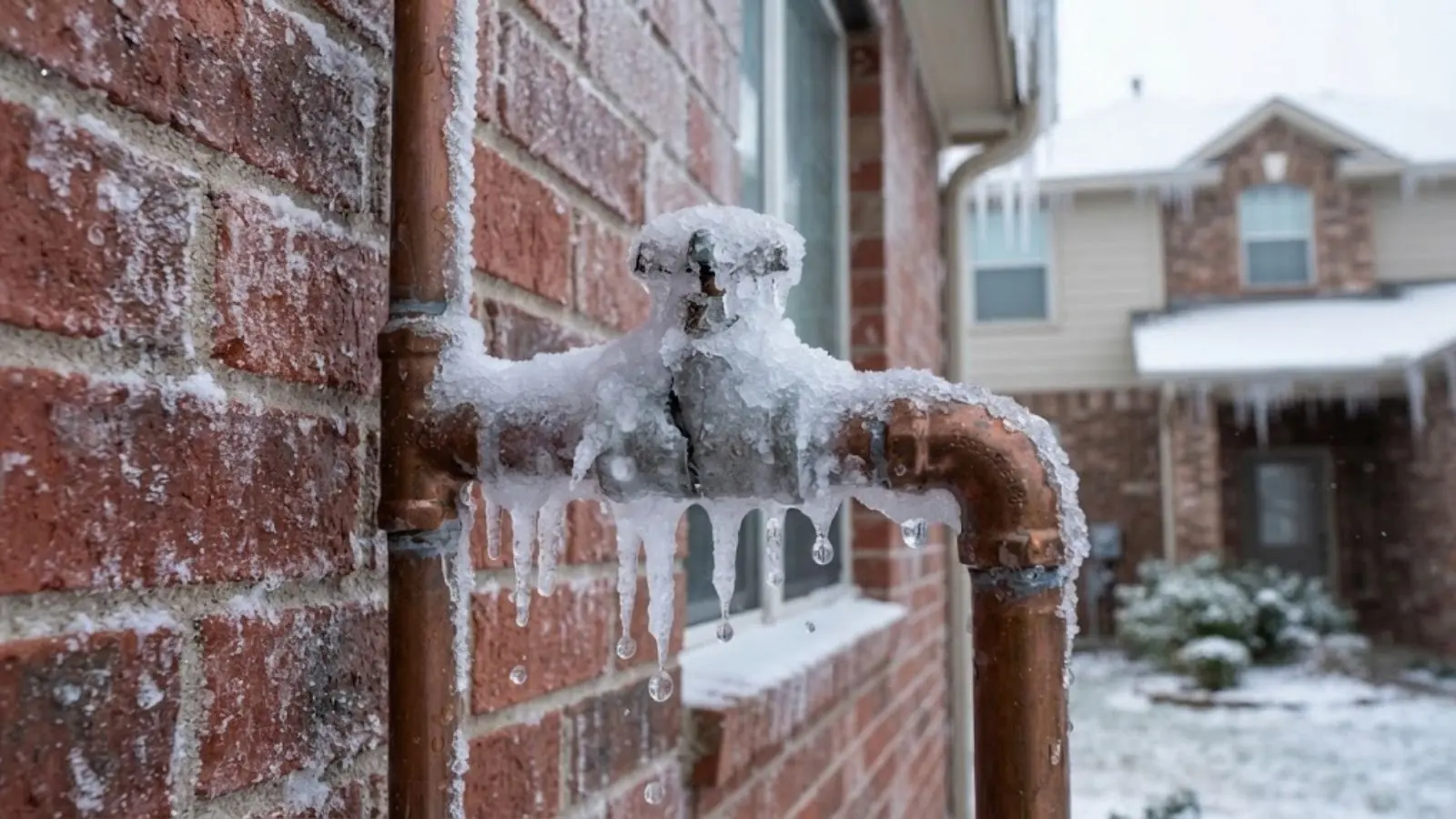
The first sign of a frozen pipe is usually a faucet that gives a trickle or nothing at all. Water inside the pipe has turned to ice, blocking flow and building pressure. The pipe may not have burst yet. What you do in the next few minutes decides whether it does.
How to confirm a pipe is frozen
Turn on the faucet. If only a trickle comes out, or nothing, look for pipes along exterior walls, in the garage, in the crawl space, in the attic or under sinks on outside walls. A frozen section often shows frost on the pipe, or feels very cold. Check whether other faucets are affected, because that tells you whether the freeze is near the main or in a single branch.
Listen for hissing or dripping inside walls, and look for water stains. Those are signs that the pipe has already split.
Thaw safely
- Open the faucet Water needs a place to go as the ice melts.
- Use gentle heat A hair dryer, a heating pad or warm towels on the pipe work. Start nearest the faucet and work toward the frozen spot.
- Never use an open flame Torches, propane heaters and kerosene heaters can ignite framing and damage pipes.
- Keep heat on in the house Open cabinet doors under sinks to let warm air reach the pipes.
- Check for leaks as it thaws A pipe that split will leak once the ice melts.
If you cannot find the frozen spot, or if the pipe is behind a wall, call a plumber.
Cannot find the frozen spot or hear water in the wall? Call the 24/7 line.
Call (860) 397-8103If a pipe has split
Shut off the main water valve right away. Open faucets to drain the lines and switch off power to any wet area. Call a plumber. The repair involves cutting out the damaged section and installing new pipe, and a pressure test confirms the line holds. Our burst pipe repair page explains the process.
Take photos of the damage before cleanup. Insurers want to see the failed pipe and the water damage.
Cold, floods and older plumbing in Windsor
Windsor sits on the Farmington and Connecticut Rivers, with winters that move between deep cold and thaw. Thaw cycles are when many splits show up, because water pressure returns as ice melts and finds the crack. The town's hazard documents also note flood-prone areas, including Batchelder Road, Pleasant Street and River Street, where a split pipe and a wet basement may arrive together.
If a freeze takes out heat in a house near a brook or river, check the basement for water as well as the pipes. A sump pump that freezes or loses power adds to the problem. Windsor is an MDC member town, so if you cannot close the shutoff inside, call the MDC about the street side.
Source type: Capitol Region Council of Governments hazard mitigation plan annex for Windsor and MDC member-town information.
Where pipes freeze in houses like yours
| Location | Why it freezes | Fix |
|---|---|---|
| Exterior wall | Little insulation between pipe and cold air | Insulate and keep cabinet doors open |
| Crawl space | Cold air moves through vents | Insulate pipes, seal gaps |
| Garage | Unheated and drafty | Heat tape and insulation |
| Attic | Pipes above insulation | Move pipes below or insulate over them |
| Outdoor spigot | Hose left attached | Disconnect hoses and shut off the inside valve |
Prevent the next freeze
Disconnect garden hoses in the fall. Insulate exposed pipes with foam sleeves. Seal gaps where cold air enters. In a hard freeze, leave a thin stream of water running at the faucet farthest from the main. Keep the heat on if you travel. Know where your main shutoff is.
If the same pipe freezes every winter, ask about rerouting it or adding heat tape. Our plumbing installation work includes moving vulnerable lines. For repeated corroded pipes, see repiping.
Nearby towns
Cold weather catches every town in the region. We respond in East Granby, where long supply runs and outbuildings make freezing common, and in Bloomfield. The same shutoff and thaw steps apply anywhere.
If you are away from home in winter
A burst pipe in an empty house can run for days. Before you leave, keep the heat on at a safe temperature, open cabinet doors under sinks on outside walls and ask someone to check the house. If you plan a long trip, shut off the main and drain the lines, or ask a plumber about winterizing.
Know where your shutoff is and make sure whoever checks the house does too. A leak sensor near the water heater or under a sink can alert your phone when water appears. Cheap sensors catch a split pipe early, long before a ceiling comes down.
How to tell a frozen pipe from a pressure problem
If every faucet in the house is weak or dry at once, the freeze may be near the main or the meter, or the service line may be affected. If only one fixture is affected, the freeze is in a branch. If hot water works but cold does not, the cold line is the problem.
A sudden loss of water in mild weather points to something other than ice, such as a closed valve or a utility outage. Check with your neighbors, check the main shutoff and call the water utility before you assume the worst.
Frequently asked questions
No. Open flames can ignite framing and damage pipes. Use a hair dryer or heating pad.
No. Thawing it slowly can avoid a split. Watch for leaks as it thaws.
In a hard freeze, a thin stream at the farthest faucet can keep water moving. Also open cabinet doors on outside walls.
Shut off the main if you hear water or see stains, and call a plumber.
Yes. The line is answered 24/7.
Plumbing problem that cannot wait? Call the 24/7 line.
Call (860) 397-8103