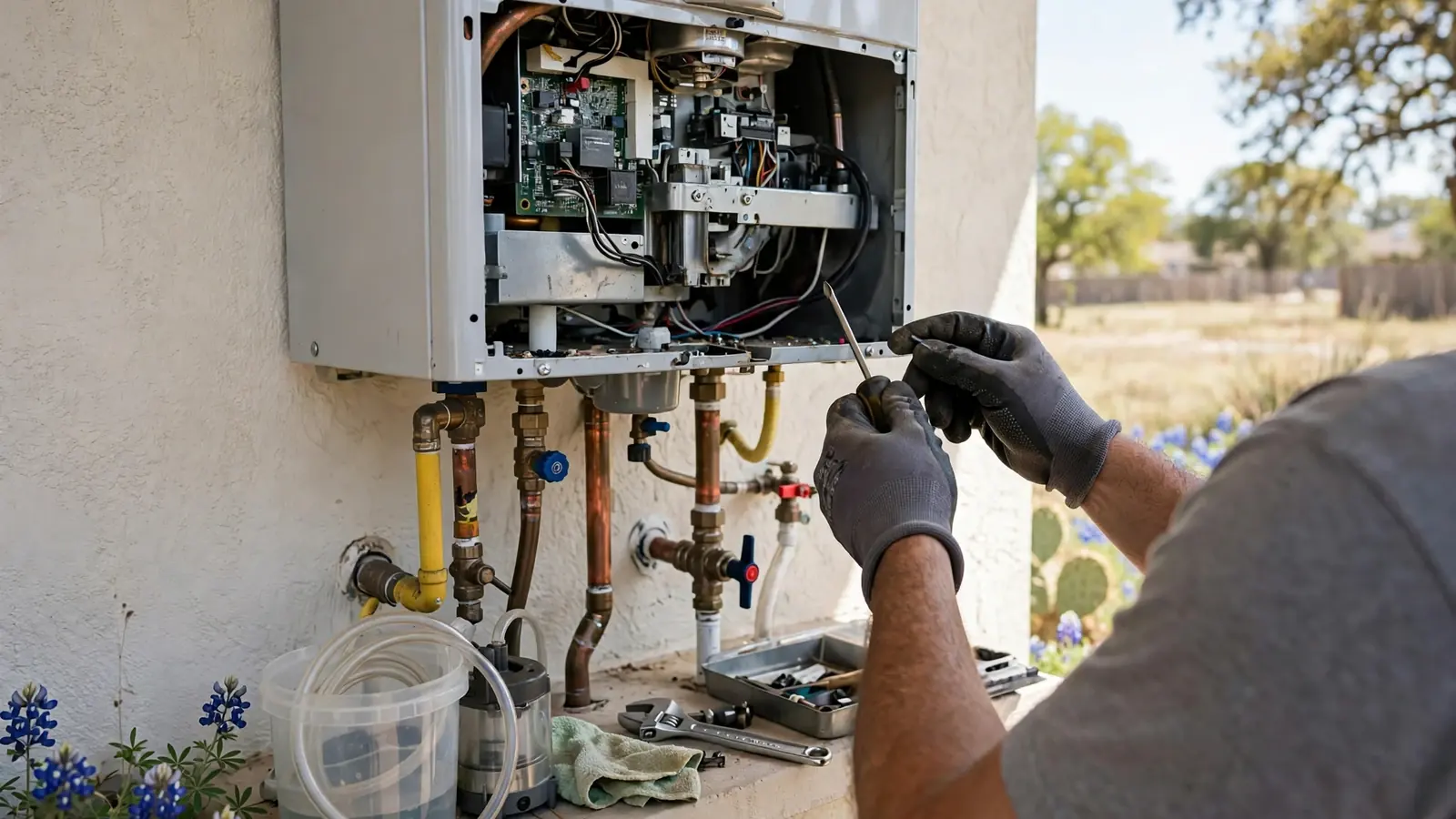
A gas tankless heater feels like it should work without power. It does not. The control board, fan, igniter and flow sensor all run on electricity, so a power outage shuts the unit down and leaves you without hot water. A battery backup can bridge short outages. A generator handles long ones. Which makes sense depends on what you want to keep running.
What a tankless unit needs power for
| Component | Why it needs power | What happens in an outage |
|---|---|---|
| Control board | Runs the sequence and safety checks | The unit will not start |
| Combustion fan | Moves air and exhaust | Burner will not run safely |
| Igniter | Lights the burner | No flame |
| Flow sensor | Detects when you open a tap | Unit does not know to fire |
| Circulation pump | Moves water in a recirculation loop | No circulation |
The draw is modest for a gas unit, usually the power of a few light bulbs to run the controls and the fan. Electric tankless units are a different story. They draw large amounts of power and cannot run on a battery backup at all.
How a battery backup works
A backup system is a battery paired with an inverter that turns stored direct current into household alternating current. When the grid goes down, the inverter takes over the circuit that feeds the heater. Runtime depends on battery capacity and the unit's draw. A gas tankless unit in use can run for a good while on a modest battery.
Some units are sold with manufacturer-matched backup kits. Others use a general uninterruptible power supply. Check the heater's power requirements, and confirm the inverter can supply them with some margin.
Want your hot water to survive the next storm? Call and we will look at your setup.
Call (860) 397-8103Backup, generator or both
A battery backup suits short outages and gives you hot water without running an engine. A portable generator handles longer outages and can run many things, though it needs fuel, safe placement outdoors and a proper transfer arrangement. A whole-house standby generator covers everything and needs professional installation.
Never plug a tankless heater into a generator through a household outlet by backfeeding the panel. That is dangerous for utility workers and for you. Use a transfer switch or an interlock installed by a licensed electrician.
Outages, storms and Windsor homes
Windsor's hazard planning documents record storm and flood events along its brooks and rivers, and the town restricts new structures in 100-year floodplains. Storms that flood basements also tend to knock out power, so a basement heater on a stand plus a way to run it through an outage works as a pair. An electric well pump in a house on a private well stops in an outage as well.
East Granby, which borders Windsor, has many homes on private wells. If a well pump is electric, a backup plan has to cover the pump as well as the heater.
Source type: Capitol Region Council of Governments hazard mitigation plan annex for Windsor and East Granby town planning documents.
Cost and maintenance of a backup
Batteries wear out. Plan on checking the unit every year and replacing the battery when it no longer holds charge. Test the backup by switching off the breaker and watching the heater start. If it does not, you have found out in daylight, not during a storm.
We help homeowners choose and install a compatible solution and coordinate with an electrician if needed. Our tankless water heater page covers installation, flushing and repair, and water heater installation covers the options when you compare tank and tankless.
A simpler alternative
If outages are common and hot water matters, a standard tank heater holds a large reserve that stays hot for hours without power. A gas tank with a standing pilot works with no electricity at all. That is one reason some homeowners choose tank units. For nearby areas, see our pages for Windsor Locks and East Granby.
Questions to ask before you buy a backup
Ask the heater manufacturer whether the unit tolerates the output of the inverter you plan to use. Some controls are sensitive to the shape of the power waveform, and a cheap inverter can cause error codes. Ask how many watts the unit draws while it fires, and how much more while it starts.
Ask how long the battery lasts at that load, how long it takes to recharge and how it signals that it is failing. Ask where it will be mounted. A battery should sit off the floor, in a ventilated place, and away from the water heater's exhaust. Choose a unit with an alarm so you learn about a dead battery before a storm does it for you.
A realistic outage plan
Decide what you need during an outage before it happens. For many households it is a hot shower and a warm kitchen, not a whole-house system. A small battery that runs a gas tankless unit for a couple of hours may cover that. If you rely on well water, plan for the pump as well, since no hot water helps if no water arrives.
Write the plan down and tape it near the unit. Include where the breaker is, how to switch to the backup and how to restart the heater afterward. Test the plan once in daylight, so the first run is not in the dark.
Frequently asked questions
Most do not. The controls, fan and igniter need power.
No. Electric tankless units draw too much power for a battery backup.
It depends on battery size and the unit's draw. Ask the manufacturer and the backup supplier for runtime figures.
For long outages, yes. For short ones, a battery is quieter and simpler.
Only with a proper transfer switch or interlock installed by a licensed electrician. Never backfeed the panel through an outlet.
Plumbing problem that cannot wait? Call the 24/7 line.
Call (860) 397-8103